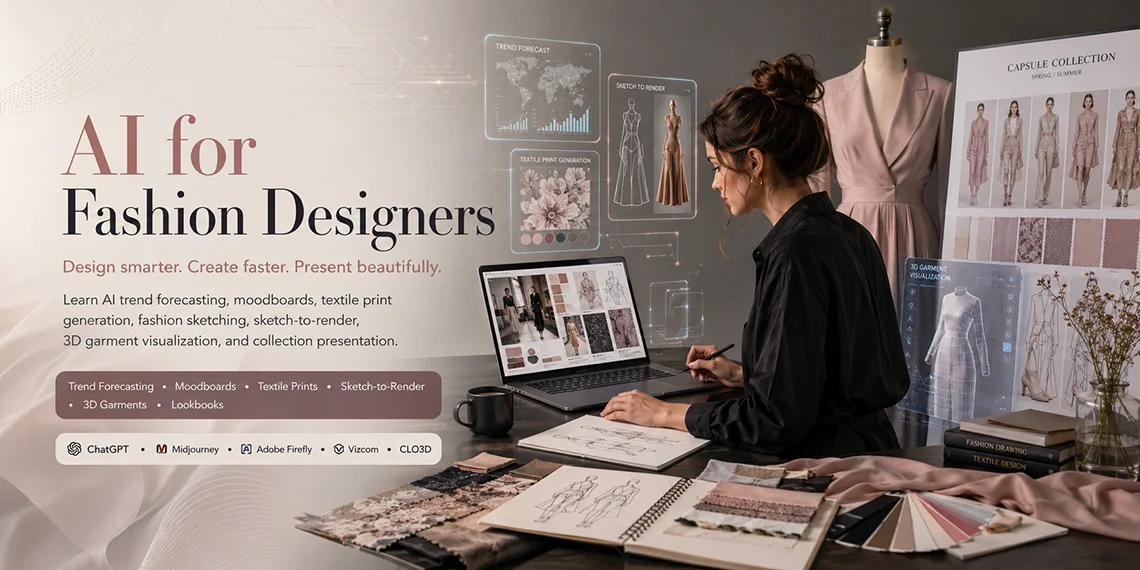
AI for Fashion Designers
Learn how to use artificial intelligence across the fashion design process, from trend forecasting and moodboards to textile prints, fashion sketching, sketch-to-render, 3D garment visualization, and collection presentation. This hands-on course combines creative ideation, technical development, and professional lookbook production so you move from concept to a complete AI-assisted capsule collection.
Duration: 16 hours
Teaching Methodology: Hands on
Course Schedule: Schedule
Fees: $400
Course Mode: Blended - Face-to-face or online via Zoom
 |
 |
 |
 |
OVERVIEW
This course is designed for fashion designers, illustrators, textile designers, and apparel brand owners who want to bring AI into their real design workflow rather than treat it as a novelty. Participants learn to research trends, build moodboards, generate original textile prints, develop fashion sketches and technical flats, visualize garments in 3D, and present a finished capsule collection as a professional lookbook. The course focuses on both creative exploration and production-ready output, helping designers move faster from concept to a presentable collection without losing their own design voice.
LEARNING OUTCOMES
By the end of this course, participants will be able to understand the role of AI in the fashion design process, use AI for trend research and mood-based concept development, write effective prompts for garment, fabric, and print generation, create original textile prints and patterns with AI, develop fashion sketches and silhouettes and turn them into technical flats, visualize garments and fits using AI-assisted 3D tools, maintain design consistency across a full capsule collection, and present finished work as a professional lookbook while applying ethical and responsible practices around AI-assisted design and originality.
AUDIENCE
Fashion designers, fashion illustrators, textile designers, pattern makers, apparel brand owners, fashion merchandisers, stylists, and fashion design students who want to use AI in their creative and technical workflow.
PREREQUISITES
Basic computer skills and general familiarity with fashion design or sketching are recommended. No advanced AI knowledge is required. Basic knowledge of Adobe Illustrator or Photoshop is helpful but not mandatory.
AI TOOLS USED IN THIS COURSE
Click below to explore the main AI tools used in this course, with official links and short practical descriptions.
AI Tools
Trend Research & Creative Ideation
Used for trend research, seasonal concept development, moodboard direction, collection storytelling, and turning a design brief into a structured creative concept.
Useful for structured collection briefs, long-form design rationale, buyer and press-facing collection descriptions, and detailed prompt refinement.
Used for visual reference research, image understanding, and multimodal ideation when working from reference photos or fabric swatches.
Image, Print & Pattern Generation
Used for fashion sketch exploration, silhouette variations, editorial-style visuals, and original textile print and pattern generation.
AI image generation and editing platform suitable for commercial-friendly prints, seamless repeat patterns, and design variations that integrate with Adobe workflows.
Useful for graphic tees, logo placement concepts, typography-based prints, and branded merchandise graphics.
Sketch-to-Render & 3D Garment Tools
AI sketch-to-render tool used to turn a hand-drawn or digital fashion sketch into a photoreal or rendered visual while keeping the designer's own linework.
3D garment simulation software used for AI-assisted draping, fit visualization, virtual fitting, and turning a technical flat into a wearable 3D preview.
Enhancement & Presentation
Useful for background removal, cleanup, relighting, and upscaling AI-generated fashion visuals for lookbooks and presentation boards.
Used to lay out moodboards, lookbooks, line sheets, and presentation decks combining AI-generated and original design work.
Used to animate lookbook visuals, create short campaign clips, and add motion to a finished collection presentation.
LEARNING OUTCOMES
After completing this course, participants will be able to:
- Research trends and build AI-assisted moodboards and color stories.
- Write strong prompts for fashion sketches, prints, and fabric concepts.
- Generate original textile prints and repeat patterns with AI.
- Develop fashion sketches, silhouettes, and technical flats using AI tools.
- Visualize garments and fit using AI-assisted 3D and sketch-to-render workflows.
- Build and present a cohesive, AI-assisted capsule collection as a professional lookbook.
RECOMMENDED LEARNING PATH
For a stronger professional workflow, we recommend the following learning path:
Frequently Asked Questions
What will I learn in the AI for Fashion Designers course?
You will learn how to use AI for trend forecasting, moodboards, textile print and pattern generation, fashion sketch development, sketch-to-render, technical flats, AI-assisted 3D garment visualization, and building a complete AI-assisted capsule collection with a professional lookbook.
Who should take this course?
This course is ideal for fashion designers, fashion illustrators, textile designers, pattern makers, apparel brand owners, fashion merchandisers, and fashion design students.
Do I need previous AI experience?
No previous AI experience is required. Basic computer skills are enough to start.
Do I need to know how to sketch or use design software?
Basic sketching or familiarity with tools such as Adobe Illustrator is helpful but not mandatory. The course teaches AI-assisted sketch-to-render workflows that support designers at different skill levels.
Is the course available online?
Yes, the course can be attended face-to-face at ETC or online via Zoom in a blended format.
How long is the course?
The course duration is 16 hours of hands-on training.
Which AI tools are used in the course?
The course covers ChatGPT and Claude for trend research and creative briefs, Midjourney and Adobe Firefly for image and print generation, Vizcom for sketch-to-render, CLO3D for AI-assisted 3D garment visualization, and Canva AI and Runway ML for lookbooks and presentation.
What projects will I create?
Practice projects include a trend-based moodboard, an original textile print, a set of fashion sketches and technical flats, a 3D-visualized garment, and a final capsule collection presented as a professional lookbook.
Do you provide certificates?
Yes, ETC issues a certificate upon successful completion of the course. ETC is a licensed school by the ministry of education.
Can I try the first session before registering?
Yes, you can attend the first session as a free trial before officially registering.
Can I pay in installments?
Yes, installment payment options are available.
Do you offer onsite training for fashion brands and studios?
Yes, ETC offers onsite training at client locations upon request.
COURSE CONTENTS
Part I - AI Foundations for Fashion Design
Module 1 - Introduction to AI in Fashion Design
- What is generative AI and how is it used in fashion today
- Where AI fits across concept, development, and presentation
- Opportunities and limitations of AI-generated fashion visuals
- Overview of the AI tools used across the course
- Ethics, copyright, and originality in AI-assisted design
Module 2 - Prompt Writing for Fashion Visuals
- Structure of an effective fashion image prompt
- Describing garment, fabric, drape, and silhouette
- Composition, pose, lighting, and styling direction
- Color and texture direction for prints and fabrics
- Negative prompts and controlling output quality
Part II - Trend Research, Concept & Textile Development
Module 3 - AI for Trend Forecasting and Moodboards
- Using ChatGPT and Gemini for trend and market research
- Building a seasonal concept from a written brief
- Developing color stories and reference moodboards
- Turning a moodboard into a design direction
Module 4 - AI-Generated Textile Prints and Patterns
- Generating original prints and repeat patterns with Midjourney and Firefly
- Creating seamless patterns for real fabric production
- Adapting AI outputs to placement prints, borders, and all-over prints
- Preparing print files for a production-ready handoff
Part III - Garment Design & Technical Development
Module 5 - AI-Generated Fashion Sketches and Silhouettes
- Generating croquis-based sketches and silhouette variations
- Exploring style options from a single concept
- Maintaining a consistent design language across sketches
- Selecting the strongest directions to develop further
Module 6 - Sketch-to-Render and Technical Flats with AI
- Turning a hand-drawn or digital sketch into a rendered visual with Vizcom
- Keeping your own linework and proportions intact
- Generating clean technical flats from a rendered concept
- Correcting common AI sketch-to-render issues
Part IV - 3D Visualization, Collection Building & Presentation
Module 7 - AI-Assisted 3D Garment Visualization
- Introduction to 3D draping and virtual fitting in CLO3D
- Turning a technical flat into a 3D garment preview
- Visualizing fit, drape, and fabric behavior before production
- Presenting a 3D garment for client or buyer review
Module 8 - Building a Cohesive AI-Assisted Collection
- Applying one concept and print story across multiple looks
- Maintaining color, silhouette, and styling consistency
- Balancing hero pieces with supporting looks
- Structuring a capsule collection from concept to final looks
Module 9 - AI for Lookbooks, Campaign Visuals and Presentation
- Generating AI model and campaign-style visuals responsibly
- Laying out moodboards, line sheets, and lookbooks in Canva AI
- Adding motion to a lookbook or campaign clip with Runway ML
- Preparing a presentation deck for buyers, press, or clients
Module 10 - Portfolio and Professional Application
- Selecting strong outputs for portfolio use
- Presenting creative process and prompt development
- Disclosing AI use responsibly to clients, buyers, and juries
- Working with brands using AI-supported design workflows
- Future opportunities in AI-assisted fashion design
Related Courses
This page is part of ETC's AI training department in Lebanon. Explore related courses: