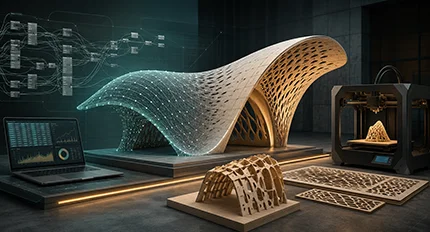
Grasshopper and AI for Rhino - Parametric Design, Generative Workflows and AI Visualization - Training Course
Master parametric design in Grasshopper, use AI assistants such as ChatGPT and Claude to develop generative .ghx definitions, and transform Rhino outputs into compelling presentation renders with AI tools such as Nano Banana.
Duration: 50 hours
Teaching Methodology: Hands-on, project-based - every module is applied to a real design problem
Course Schedule: Schedule
Fees: $900
Course Mode: Blended - Face-to-face or online via Zoom
 |
 |
 |
 |
DESCRIPTION
Grasshopper is a visual programming language and environment that works within Rhino, a 3D modeling and CAD software. It allows architects, jewelry designers and product designers to create complex parametric designs by visually connecting components ("nodes") to define relationships and generate geometry. Grasshopper enables users to explore, manipulate and optimize designs iteratively, making it a powerful tool for algorithmic modeling and generative design across disciplines.
This 50-hour, fully hands-on Grasshopper and AI course teaches algorithmic modeling and parametric design through real, discipline-specific projects: parametric facades and massing studies for architects, parametric jewelry components for jewelry designers, and configurable products and furniture - including a fully parametric table - for product designers.
Participants also learn an emerging AI-assisted workflow: translating a design intention into a precise specification, asking tools such as ChatGPT and Claude to generate or improve Grasshopper definitions and .ghx files, validating the resulting logic inside Rhino, and producing design visualizations with AI rendering tools such as Nano Banana.
OBJECTIVES
After completing this course, participants will be able to:
- Understand parametric and algorithmic design principles across architecture, jewelry and product design.
- Work with Rhino geometry, data types and their properties inside Grasshopper.
- Build and manage data structures, including lists and data trees.
- Apply attractor-based and data-driven design logic to generate variation.
- Write and debug custom components using Python and C# scripting.
- Use ChatGPT, Claude and similar AI assistants to plan, generate, inspect and improve Grasshopper .ghx definitions.
- Validate AI-generated components, dependencies, geometry and data-tree behavior before using a definition in production.
- Prepare Grasshopper and Rhino outputs for AI-assisted rendering and create controlled visualizations with tools such as Nano Banana.
- Design parametric building facades, envelopes and massing studies.
- Design parametric jewelry components, including gemstone-driven patterns.
- Design parametric furniture and product families, including a configurable table.
- Apply mesh modeling, subdivision and organic form techniques.
- Use optimization and form-finding tools such as Galapagos.
- Prepare parametric geometry for digital fabrication, casting and 3D printing.
- Build a complete, portfolio-ready parametric project in their own discipline.
AUDIENCE
This course is for architects, jewelry designers, product and furniture designers, and engineers who want to master parametric and generative design using Grasshopper inside Rhino and extend their workflow with AI-assisted definition creation and visualization. Hands-on exercises apply directly to architectural facades and massing, parametric jewelry components, and product and furniture design, including a fully configurable parametric table.
PREREQUISITES
None required. This course is open to architects, jewelry designers, product and furniture designers, and CAD professionals from any 3D modeling background. General familiarity with 3D CAD concepts is helpful but not mandatory; essential Rhino skills needed for Grasshopper are introduced within the course. Rhino 1 - Fundamentals for All is recommended for participants with no prior 3D modeling exposure, but it is not a prerequisite.
COURSE CONTENTS:
01 - Foundations of Parametric and Algorithmic Design
- Principles of parametric and algorithmic design versus traditional direct modeling
- Grasshopper interface, canvas organization and Rhino integration
- Core data types: Number, Point, Vector, Curve, Surface, Boolean, Geometry
- Parameters, components, wires and preview management
- Baking, grouping and file organization for large definitions
- Hands-on exercise: building a first parametric definition and comparing it to an equivalent direct-modeling workflow

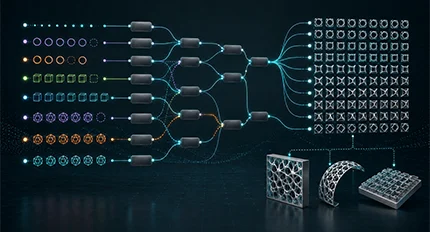
02 - Data, Lists and Data Trees
- List basics: indexing, sorting, culling and list item access
- Data matching and stream logic (shortest list, longest list, cross reference)
- Introduction to data trees: branches, paths and structure
- Tree manipulation: graft, flatten, simplify, merge, explode and shift
- Debugging tree mismatches, a common source of errors
- Hands-on exercise: generating a parametric matrix of repeating units, later reused for a facade panel, a jewelry lattice and a product grid
03 - Curves, Surfaces and Geometry Control
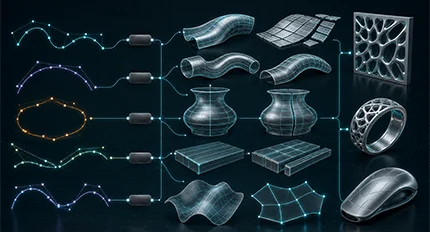
- Curve creation, editing and analysis (degree, control points, continuity)
- Surface creation methods: loft, sweep, network surface, revolve, extrude
- Curve and surface parameters: evaluate, divide, project, pull, flow
- Isotrim, subsurfaces and working with UV domains
- Surface and curve continuity for manufacturable geometry
- Hands-on exercise: form studies applicable to a facade panel, a jewelry band and a product shell
04 - Vectors, Planes and Transformations
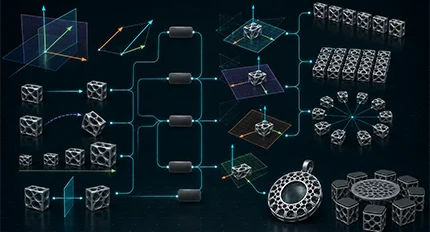
- Vector mathematics and plane construction
- Move, rotate, scale, mirror and orient operations
- Linear, polar and rectangular arrays
- Remapping geometry between coordinate systems
- Hands-on exercise: building radial and modular arrangements used in jewelry components and furniture layouts
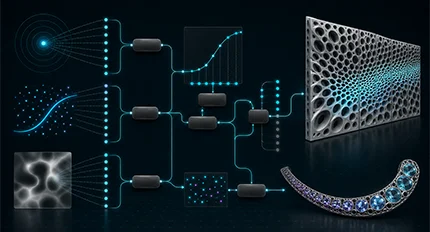
05 - Attractor-Based and Data-Driven Design
- Point, curve and image-based attractors
- Number remapping, domains and the Graph Mapper component
- Conditional statements and expressions in Grasshopper
- Controlled randomness and pattern variation
- Hands-on exercise: an attractor-driven facade panelization study and a gradient-based gemstone or bead pattern
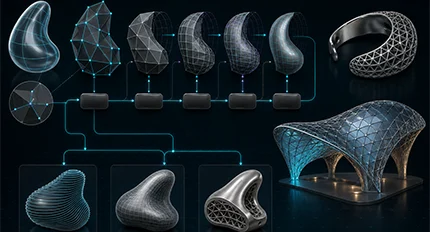
06 - Mesh Modeling and Subdivision
- Mesh fundamentals: vertices, faces, edges and topology
- Converting NURBS geometry to mesh and back
- Subdivision, relaxation and smoothing workflows
- Preparing mesh geometry for rendering, 3D printing and casting
- Hands-on exercise: an organic jewelry form and a faceted architectural shell built from the same mesh logic
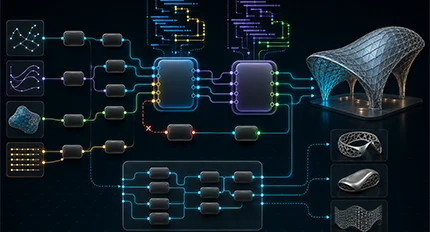
07 - Scripting with Python and C# in Grasshopper
- Introduction to the GhPython and C# scripting components
- Writing custom logic when native components are not enough
- Handling data trees, inputs and outputs inside scripts
- Debugging scripted components
- Building reusable custom components and clusters
- Hands-on exercise: a script-driven definition solving a specific design problem chosen by the participant
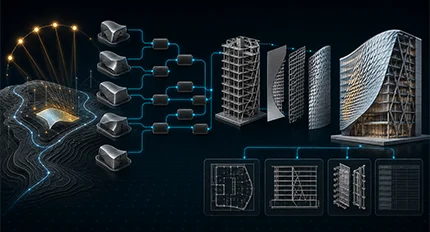
08 - Parametric Architecture Applications
- Facade and building envelope systems: paneling, perforation, shading devices
- Site analysis and generative massing studies
- Structural and space-frame logic
- Introduction to environmental analysis-driven design (sun path and solar exposure concepts)
- Producing architectural drawings and schedules from a parametric model
- Hands-on exercise: a complete parametric facade or building massing study, from concept to construction-ready output
09 - Parametric Jewelry Design Applications
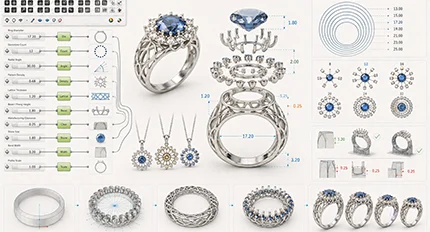
- Radial and symmetry-based jewelry components: rings, pendants, bezels
- Gemstone setting logic and parametric stone arrays
- Organic and lattice-based jewelry structures
- Sizing logic and parametric ring and finger-size adjustment
- Preparing jewelry geometry for casting and 3D printing tolerances
- Hands-on exercise: a fully parametric ring or pendant family with adjustable size, stone count and pattern density
10 - Parametric Product and Furniture Design Applications
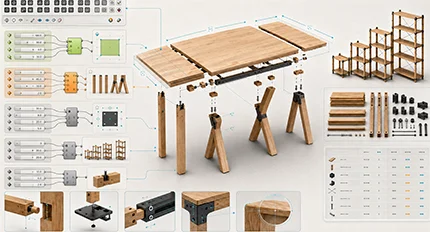
- Parametric furniture design: the parametric table exercise, with adjustable dimensions, leg configuration and joinery logic
- Modular product families and mass-customization principles
- Building simple configurators that link sliders and inputs to product variants
- Joinery, tolerances and assembly logic for manufacturing
- Bill of materials and dimension export for production
- Hands-on exercise: a fully configurable parametric table and a modular shelving or product family
11 - Optimization and Form-Finding
- The Galapagos evolutionary solver for design optimization
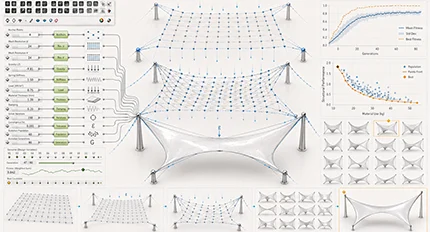
- Physics-based form-finding: structural draping and tensile or organic forms
- Defining fitness criteria and multi-objective exploration
- Hands-on exercise: optimizing a design variant against a defined goal such as material use, weight or aesthetic fitness
12 - AI-Assisted Grasshopper with Codex and Claude Code
- Defining geometry, parameters, constraints and outputs in a structured AI brief
- Using ChatGPT and Claude to develop Grasshopper logic and workflows
- Using Codex and Claude Code to create, edit and organize .ghx files and Rhino Python scripts
- Generating clear definitions with sliders, groups, notes and separated outputs
- Checking Rhino versions, component GUIDs, plugins, units and data-tree behavior
- Debugging through iterative prompting, testing, versioning and human review
- Hands-on exercise: generate and refine a working parametric design as an editable .ghx file

13 - AI Rendering and Generative Design Visualization
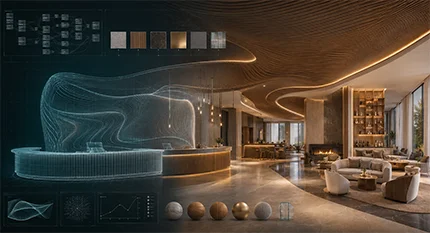
- Preparing Rhino views, linework, clay renders and object masks for AI visualization
- Using Nano Banana and similar tools for rendering, editing and visual exploration
- Prompting for materials, lighting, context, scale, mood and presentation style
- Using reference images while preserving the original design and geometry
- Creating consistent architectural, interior, jewelry and product-design presentations
- Recognizing AI distortions, copyright concerns and the limits of concept imagery
- Hands-on exercise: produce an AI-rendered presentation from a Grasshopper model
14 - Digital Fabrication, Data Export and Capstone Project
- Introduction to digital fabrication workflows: CNC, laser cutting and 3D printing preparation
- Data export to Excel and CSV for production schedules and bills of materials
- Extending Rhino with Grasshopper Player and simple custom user interfaces
- Final capstone project: a complete parametric design developed end-to-end in the participant's own discipline (architecture, jewelry or product design)
- Using AI appropriately to support definition development, troubleshooting and visualization while retaining designer control
- Hands-on exercise: presenting and documenting the capstone project as a portfolio-ready piece