Fashion Illustration Course in Lebanon - Croquis, Fashion Flats and Fabric Rendering
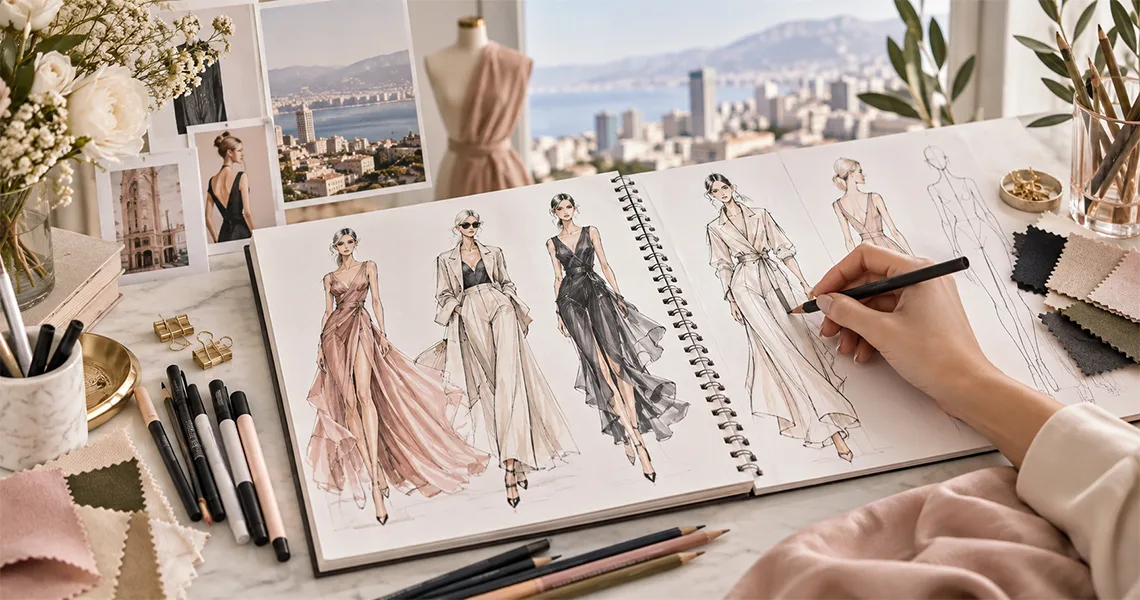
A design that cannot be drawn clearly cannot be sold, sampled, or produced. ETC's Fashion Illustration course trains you to put a garment idea on paper twice: as an expressive illustration on a posed figure, and as an accurate technical flat a pattern maker can work from. Nine practical sessions, one finished look.
Duration: 18 hours (9 sessions x 2 hours)
Teaching Methodology: Live Demonstration, Guided Drawing, and Individual Critique
Course Schedule: Schedule
Fees $360
Course Mode: Face-to-Face
 |
 |
 |
 |
DESCRIPTION
Fashion illustration is the working language between a designer, a client, a pattern maker, and a workshop. This course treats it that way: as a professional skill built step by step, not as a talent you either have or do not.
You start with line control and the proportions of the fashion figure, then build a set of reusable croquis in the poses designers rely on most. From there you learn to dress the figure believably, showing how fabric sits, pulls, and falls on the body. Alongside every illustration you produce the matching technical flat, the drawing the industry actually manufactures from. The final sessions cover color, marker rendering, and the textures and prints that make a fabric readable at a glance, ending with one complete, critiqued look.
Every session follows the same rhythm: the instructor demonstrates, you draw, and your work is corrected individually on the page.
WHAT YOU WILL BE ABLE TO DO
- Draw a correctly proportioned fashion figure using a 9-head grid and a balance line
- Pose the croquis in front, three-quarter, and walking views with convincing weight shift
- Stylize heads, hands, feet, and hair so they support the garment instead of competing with it
- Draw tops, outerwear, skirts, trousers, and dresses with correct fit, ease, and silhouette
- Show how fabric behaves on the body: tension folds, drape, gathers, and hems in perspective
- Produce clean, symmetrical technical flats with stitching, closures, and construction details
- Build a color palette and render with markers and colored pencils using a consistent light source
- Render recognizable fabrics and prints: denim, knits, sheers, satin, leather, stripes, and checks
- Take a design from mood board and thumbnails to a finished illustration with its matching flat
AUDIENCE
Fashion design students, people preparing for a fashion design degree or career, home sewers and small-label owners who need to communicate their designs, and designers from interior, graphic, or architectural backgrounds moving into fashion.
PREREQUISITES
No fashion illustration experience is required. Some comfort with a pencil helps; willingness to practice between sessions matters more.
Certifications & Accreditations
ETC Expertise Training Center is a licensed educational institution in Lebanon. Participants who successfully complete the course receive a Certificate of Completion from ETC Expertise Training Center.
Students who meet the requirements outlined in ETC's certification roadmap may also qualify for ETC certificates attested by the Lebanese Ministry of Education, providing locally attested professional certification.
Frequently Asked Questions
Who should take this course?
Fashion design students, people planning a career in fashion, home sewers and small-label owners who want to present their ideas clearly, and designers from other fields moving into fashion.
Do I need to know how to draw?
No prior fashion illustration experience is needed. The course starts with line control and proportion. Some comfort with a pencil helps, but regular practice matters more than talent.
COURSE CONTENTS
Session 1 - Line, Tools, and Fashion Proportion
- Where illustration fits in the design workflow: idea, sketch, flat, sample
- Pencils, fineliners, markers, and papers: what each is for
- Line weight and confident single strokes: warm-up drills
- Realistic vs. fashion proportion: why the figure is elongated
- The 9-head grid: key landmarks from crown to ankle
- The balance line and center front line
- Exercise: a standing front-view figure on the grid
Session 2 - Posing the Croquis
- Gesture first: capturing the pose in a few lines
- Weight shift: opposing tilt of shoulders and hips
- Supporting leg vs. free leg and keeping the figure balanced
- The three-quarter view and turning the center front line
- The runway walking pose
- Common errors: floating feet, rigid arms, uneven lengths
- Output: a personal set of reusable croquis templates
Session 3 - Heads, Hands, Feet, and Hair
- Head construction and placement of the features
- Stylizing the face: how much detail a fashion drawing needs
- Head angles that match the body pose
- Simplified hands: resting, on the hip, holding an accessory
- Feet in flat shoes and heels, front and three-quarter
- Hair as mass and direction, not individual strands
Session 4 - Dressing the Figure: Tops and Outerwear
- Fit and ease: the space between body and garment
- Silhouette families and how they change the read of a look
- Necklines and collars that wrap around the neck
- Sleeves: set-in, raglan, puff, and how they bend at the elbow
- Shirts, blouses, knit tops, jackets, and coats on the posed figure
- Exercise: one top layered under one jacket
Session 5 - Skirts, Trousers, Dresses, and Drape
- Waistbands and the curve of the body
- Skirt shapes: pencil, A-line, circle, pleated
- Trousers on a moving leg: break, crease, and hem
- Dresses from fitted to fluid
- Fold types: tension, drape, gather, and spiral folds
- Drawing hems in perspective so they wrap the figure
Session 6 - Technical Flats
- Illustration vs. flat: two drawings, two audiences
- Building a flat from a body template
- Symmetry: drawing half and mirroring
- Front and back views
- Seams, darts, topstitching, buttons, zippers, and pockets
- Line hierarchy: outline, seam, and stitch weights
- Exercise: flats for the garments drawn in Sessions 4 and 5
Session 7 - Color and Marker Rendering
- Building a fashion color palette: hue, value, and saturation
- Skin tones: mixing and layering a range
- Marker technique: base tone, layering, and avoiding streaks
- Choosing one light source and staying consistent
- Highlight, mid-tone, and shadow on fabric
- Colored pencil for detail and soft transitions
Session 8 - Rendering Fabrics and Prints
- Matte vs. shiny: how light behaves on different fabrics
- Denim, knits, and wool
- Sheers and layered transparency
- Satin, silk, and leather highlights
- Stripes, checks, and prints that follow the body
- Output: a reference sheet of rendered fabric swatches
Session 9 - Final Look: Concept to Presentation
- A one-page mood board: theme, palette, and fabric direction
- Three thumbnail concepts and selecting the strongest
- Final rendered illustration on a chosen croquis
- Matching front and back technical flat
- Layout of the presentation page
- Individual instructor critique and next steps for a portfolio
Related Courses
This course is part of ETC's Fashion Design training program in Lebanon. Continue your path with:
- Fashion Design Using Adobe Illustrator and Photoshop - the natural next step for digital flats and presentation boards
- Adobe Illustrator Essentials
- Adobe Photoshop Essentials
- All Fashion Design Courses in Lebanon