ISO 19650 for BIM Information Management - Course in Lebanon
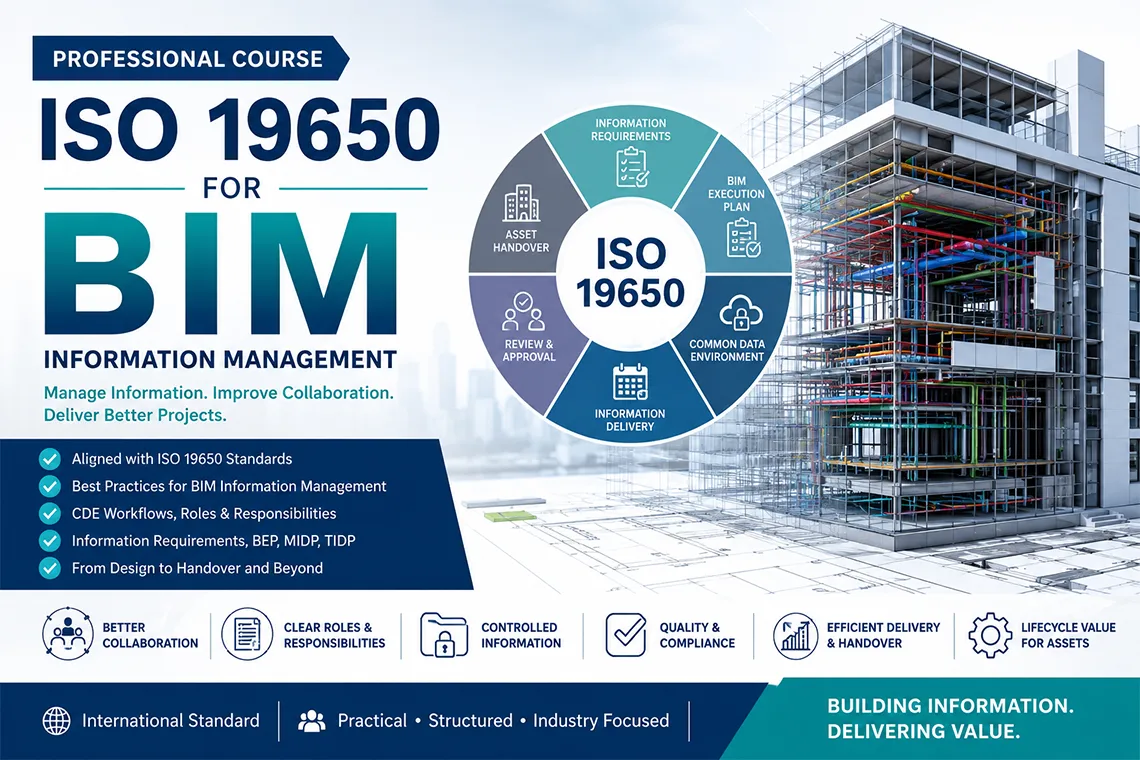
Learn how to manage BIM project information according to international standards at ETC in Lebanon. This professional course follows the ISO 19650 delivery process from start to finish: information requirements, BIM Execution Plans, CDE workflows, information container identification, delivery planning, and asset handover.
Duration: 30 hours
Teaching Methodology: Hands-on workshops
Course Schedule: Schedule
Fees Call
Course Mode: Blended Face-to-face or online via Zoom
 |
 |
 |
 |
DESCRIPTION
More and more clients, consultants, and contractors require project information to be managed according to ISO 19650. This course teaches participants how to apply the framework on real BIM projects: what the appointing party must define, what each delivery team must produce, and how information moves from work in progress to an approved, handed-over asset information model.
The course covers ISO 19650-1 (concepts and principles) and ISO 19650-2 (information management during the delivery phase) in depth, with introductions to ISO 19650-3 (operational phase), ISO 19650-4 (information exchange), ISO 19650-5 (security-minded approach), and ISO 7817-1 (level of information need).
One course project, start to finish. All exercises are built on a single case project: a mid-rise mixed-use building with architecture, structure, MEP, and contractor teams. Students write its information requirements, prepare its BEP, set up its CDE, define its naming convention, plan its deliveries, and close it out at handover. The capstone workshop assembles this work into a complete information management plan, followed by a final assessment.
OVERVIEW
Participants who complete this course will be able to:
- Explain the structure of the ISO 19650 series and the role of each part
- Apply the ISO 19650-2 information management process, from assessment and need to project close-out
- Define and interpret information requirements: OIR, AIR, PIR, and EIR
- Specify level of information need instead of generic LOD labels
- Prepare a BIM Execution Plan, both pre- and post-appointment
- Set up and manage a Common Data Environment with correct state transitions and approval workflows
- Define a project information container identification convention, with revision and suitability codes
- Create a Master Information Delivery Plan and Task Information Delivery Plans
- Manage information review, acceptance, and handover to facility management
AUDIENCE
Architects, engineers, BIM modelers, BIM coordinators, BIM managers, project managers, contractors, consultants, facility managers, and client representatives involved in BIM-enabled projects.
PREREQUISITES
Familiarity with BIM concepts and general project workflows is recommended. Prior experience with Revit or other BIM software is helpful but not required.
RECOMMENDED LEVEL
Intermediate to professional level. Suitable for practitioners who are already working on or managing BIM projects and need to align their processes with international standards.
Certifications & Accreditations
Participants who successfully complete the course receive a Certificate of Completion from ETC Expertise Training Center, a licensed school accredited by the Lebanese Ministry of Education.
Students who meet the requirements outlined in ETC's certification roadmap may also qualify for Ministry of Education attestation. This is a professional training course and is not a third-party ISO certification scheme.
Frequently Asked Questions
What is ISO 19650 and why is it important for BIM professionals?
ISO 19650 is an international series of standards for managing information over the whole life cycle of a built asset using BIM. It defines how information should be specified, produced, shared, approved, and delivered on construction projects, enabling better collaboration between all parties involved.
Who should attend the ISO 19650 course at ETC?
The course is designed for architects, engineers, BIM coordinators, BIM managers, project managers, contractors, consultants, facility managers, and client representatives who work on BIM projects and need to apply ISO 19650 processes.
COURSE CONTENTS
Module 1 - ISO 19650 Fundamentals and Terminology
- What BIM really means: model vs information
- Why ISO 19650 was created and how it evolved from BS 1192 and PAS 1192
- Structure of the series: ISO 19650 Parts 1 to 5 and what each covers
- Appointing party, lead appointed party, appointed party
- Delivery team and task team
- Information container and information model
- Project Information Model, PIM, and Asset Information Model, AIM
- Project information vs asset information
- Benefits for owners, consultants, contractors, and facility managers
Practical exercise: Students identify the appointing party, delivery teams, and task teams of the course project.
Module 2 - The ISO 19650-2 Information Management Process
- The eight process activities: assessment and need, invitation to tender, tender response, appointment, mobilization, collaborative production of information, information model delivery, and project close-out
- Who leads each activity and what it produces
- Project information standard
- Project information production methods and procedures
- Information protocol and its place in appointments
- Capability and capacity assessment
- Mobilization plan
- Information delivery risk register
Practical exercise: Students map the course project timeline to the eight process activities.
Module 3 - Information Requirements
- OIR - Organizational Information Requirements
- AIR - Asset Information Requirements
- PIR - Project Information Requirements
- EIR - Exchange Information Requirements
- How the appointing party defines information needs
- Geometrical information, alphanumerical information, and documentation
- Level of information need according to ISO 7817-1, and why generic LOD labels are not enough
- How to avoid asking for unnecessary BIM data
Practical exercise: Students write the EIR for the course project.
Module 4 - BIM Execution Plan According to ISO 19650
- What is a BEP?
- Pre-appointment BEP
- Post-appointment BEP
- BIM goals and uses
- Project roles and responsibilities
- Federation strategy and information container breakdown structure
- Model coordination strategy and clash detection responsibilities
- Software platforms and exchange formats
- Deliverable schedule
Practical exercise: Students prepare a pre-appointment BEP for the course project in response to their EIR.
Module 5 - Common Data Environment, CDE
- What is a Common Data Environment?
- Work in Progress state
- Shared state
- Published state
- Archived state
- State transitions: check, review, approve, and authorize
- Revision control
- Transmittals and issue history
- Access permissions
- Platforms: Autodesk Docs (Autodesk Forma), Trimble Connect, SharePoint-based systems
Practical exercise: Students set up the CDE folder structure, states, and approval workflow for the course project in Autodesk Docs.
Module 6 - Information Container Identification, Metadata, and Revision Control
- What ISO 19650-2 requires: unique, consistent identification of every information container
- Defining the convention in the project information standard
- The UK National Annex convention, the most widely adopted example: project, originator, volume/system, level/location, type, role, and number fields
- Suitability and status codes as defined in the UK National Annex
- Revision codes for work in progress and published information
- Client-specific variants used on regional projects
- Naming models, drawings, schedules, reports, and documents
- Common mistakes in BIM file naming
Practical exercise: Students define the course project's naming convention and rename a set of sample files accordingly.
Module 7 - Information Delivery Planning
- Building the responsibility matrix
- TIDP - Task Information Delivery Plan
- MIDP - Master Information Delivery Plan
- Deliverable dates and information delivery milestones
- Who produces what and when
- Coordination between disciplines
- Design stages and information exchanges
- Model review checkpoints
- Quality control before submission
Practical exercise: Students build TIDPs and the MIDP for the architecture, structure, and MEP teams of the course project.
Module 8 - Information Production, Checking, and Exchange
- Information exchange principles (ISO 19650-4)
- Quality assurance during collaborative production
- Model checking and document checking
- Review by the lead appointed party before submission
- Review and acceptance of the information model by the appointing party
- Accepted, rejected, and revised information
- Recording review outcomes and comments in the CDE
Practical exercise: Students review a submission package from the course project, record issues, and decide whether to accept or reject it.
Module 9 - Handover, Asset Information, and Security
- Project close-out activities
- Handover information and the Asset Information Model
- COBie as an example of structured asset data
- Linking ISO 19650 to facility management and the operational phase (ISO 19650-3)
- Security-minded information management (ISO 19650-5)
- Lessons learned and their capture for future projects
Practical exercise: Students define the handover information set and the asset data requirements for the course project.
Module 10 - Capstone Workshop and Final Assessment
- Assembling the course project deliverables into one information management plan
- Consistency check: EIR, BEP, CDE setup, naming convention, and MIDP
- Presentation of the plan by each team
- Peer and instructor review using appointing-party criteria
- Final assessment on ISO 19650 concepts and process
Final workshop: Students present a complete ISO 19650 information management plan for the course project and complete the final assessment.
Related Courses
This course is part of ETC's BIM training program in Lebanon. Explore the other courses in the department: